Planning guides · Start here
How to Plan Your First African Safari
A first safari feels overwhelming because it looks like a hundred decisions at once – which country, which month, which camp, which operator. It isn't. It's seven decisions in a sensible order, and each one narrows the next. Get the sequence right – who and what first, destination and dates second, the details last – and the trip more or less designs itself. This is the map; every step links to a deeper guide when you need it.
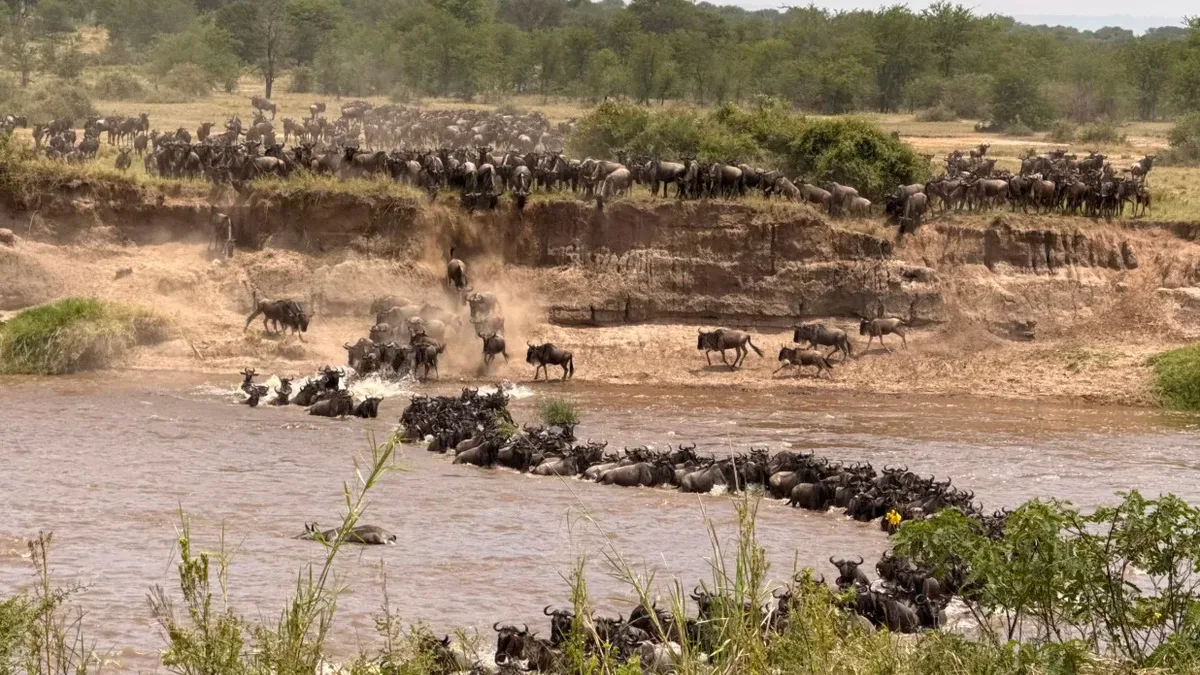
A wildebeest herd crosses a river in northern Serengeti in October 2025. The Safari Atlas
The quick answer
Plan in this order: 1) decide who's travelling and what you most want; 2) choose a country; 3) pick your month; 4) set how many nights; 5) choose your tier and camps; 6) build the route; 7) book safely with a vetted operator. For most first-timers that lands on a mid-range, 5–7 night trip in Kenya, Tanzania or South Africa, in a private vehicle; our editorial planning estimate is roughly $450–$800 per person per day.
Don't try to see everything. Fewer places, more nights, the right season, and an operator you trust – those four get you 90% of a great first safari.
Key facts
- Plan in order: who/what → country → month → nights → tier/camps → route → operator.
- Best first countries: Kenya and Tanzania for the classics; South Africa for value and malaria-free family trips.
- Sweet spot: 5–7 nights on the ground, mid-range, private vehicle for two.
- Typical cost: our editorial planning estimate is about $450–$800 per person per day mid-range, before international flights.
- Book early: the best camps and peak dates sell out a year or more ahead.
- The wildlife is the same at every tier – spend on time, guiding and location, not luxury alone.
The seven-step plan
Here's the whole thing on one screen. Work top to bottom – each step feeds the next – and don't jump ahead to camps and vehicles before you've settled who's going and when.
Decide who's travelling and what you want
Family, couple, solo or group – and the one thing you most want: the migration, gorillas, a malaria-free trip, or just a great first safari.
Choose a country
Kenya or Tanzania for the icons and the migration; South Africa for value, self-drive and malaria-free family reserves.
Pick your month
Season shapes both wildlife and price. Match the month to what you want – and often the month decides the country.
Set how many nights
Strip out the flying days. Aim for 5–7 nights on the ground – enough for two or three areas without rushing.
Choose your tier and camps
Budget, mid-range or luxury – the wildlife is the same. Pick camps by location first, luxury second.
Build the route
Two or three parks, sequenced one way, headline park last. Drive short legs, fly long ones.
Book safely
Use a vetted operator, get park fees included in writing, and understand the deposit and cancellation terms before you pay.
Steps 1–2: who, what, where
Start with people, not places. Who is travelling – a couple, a family with young children, a solo traveller, a group – and what is the one thing you most want from the trip shapes everything downstream. A family leans toward malaria-free reserves and child-friendly camps; a honeymoon toward privacy and romance; a photographer toward a private vehicle and time. Name your traveller type and your must-see first, and the noise falls away, exactly as our safari styles guide sets out.
Those answers point to a country. Kenya and Tanzania are the classic first choices – iconic parks, the Great Migration, strong value; South Africa is the easiest and most affordable, with self-drive options and unique malaria-free Big Five reserves; Botswana is premium and remote; Uganda and Rwanda are for gorillas. Our best safari destinations guide and the head-to-heads – Kenya vs Tanzania, South Africa vs Kenya – settle the choice between any two.
Steps 3–4: when and how long
When comes next, because season shapes both the wildlife and the bill – and often decides the country. The migration crossings are a July-to-October event; the calving is January to March; peak dry season is easiest but priciest; the green season is cheaper and quieter. If your dates are fixed, aim them at what that month does best, as our best time to go and safari-by-month calendar lay out. If your must-see has a season, that season sets your dates.
Then fix how many nights – and count nights on the ground, not brochure "days", because international flights swallow the first and last. Three nights is the floor; five to seven is the sweet spot for a first safari; ten if you're combining regions or adding a beach. More is not automatically better – fewer places with more time beats a park-a-day dash, as our how many days on safari guide argues.
Want your whole first safari planned for you?
Tell us who's travelling, roughly when, and the one thing you most want to see, and our safari planning team will turn it into a costed first-safari plan – country, month, nights, camps and route – with fees included. No obligation.
Steps 5–6: stay and route
Now the details start to fall into place. Choose your tier honestly: budget, mid-range or luxury all see the same wildlife, so decide whether you're buying comfort or just the animals – and for most first-timers, mid-range is the value sweet spot, as our budget vs luxury guide explains. Then pick camps by location first: a well-placed simple camp beats a plush one an hour from the wildlife, and the lodge-versus-tent choice is about immersion, not luxury, per our accommodation guide.
Finally, build the route: two or three complementary parks, sequenced to flow in one direction, with the headline park saved for last, and transfers matched to distance – drive the short scenic legs, fly the long rough ones. Our itinerary-building guide walks through it, and ready routes like the 7-day Kenya itinerary give you a proven starting shape to adapt.
Step 7: book safely
The last step protects everything before it. Choose a vetted operator – not simply the cheapest quote, which often hides a packed vehicle or corners cut – using the checks in our choosing an operator guide. Insist that park and conservation fees are included in writing, because they're the biggest hidden line and the main reason two quotes differ; our hidden costs and is your quote fair guides show what to look for.
Before you pay, understand the deposit and cancellation terms – a non-refundable deposit of around 20–40% is normal, with the balance due 60–90 days out – and take out travel insurance, which is the one saving never worth making. Then book early: the best camps and peak-season dates go a year or more ahead. Do this properly and the trip you planned is the trip you get.
The planning map
The seven steps as a single flow – who and what at the top narrowing down to a booked trip. Follow the arrows and you can't get lost.
The first-safari planning flow
Five questions to answer before you plan
- Who's travelling, and what do we most want? This first answer shapes every choice after it.
- When can we go? Season shapes wildlife and price – and often decides the country.
- How many nights, really? Count nights in camp, not flying days – aim for five to seven.
- What's our budget per day? Our editorial planning estimate for mid-range is roughly $450–$800 pp/day and the value sweet spot.
- Who will we book with? A vetted operator with fees included beats the cheapest quote every time.
So where should you start?
Before any destination, settle who's travelling and the one thing you most want. A malaria-free family trip, the migration, gorillas, or a classic first safari – that answer points to everything else.
For most first-timers: Kenya, Tanzania or South Africa; a mid-range, 5–7 night trip; a private vehicle; two or three parks. It's the well-trodden path because it works.
The right season, enough nights, well-located camps, and a trusted operator. Get those four right and the rest is detail – and your first safari will be everything you hoped.
Plan in order and a first safari stops being overwhelming and becomes a sequence of clear, satisfying choices. Start with who you are and what you want, lean on the linked guides at each step, and book with someone you trust. The greatest wildlife theatre on earth is more reachable than it looks.
Planning guidance, costs and timings are typical 2026 figures and vary by destination, season and operator. Park fees follow official schedules current at July 2026. Confirm current rates, availability and booking terms with your operator before booking.
Sources & notes
First-safari planning guidance here reflects widely used industry practice. Cost benchmarks and booking-term norms (deposits of roughly 20–40%, balance 60–90 days out) are consistent across independent sources; park fees follow the TANAPA and Maasai Mara (Narok County) schedules. Figures vary by season and operator – confirm current rates and terms before booking.