Accommodation guides · Regional
Central, North or South Serengeti: Where Should You Stay?
The Serengeti is the size of a small country, so "staying in the Serengeti" tells you almost nothing – a camp in the south and one in the north can be a full day's drive and an entirely different safari apart. The single question that decides where to base yourself isn't budget or luxury. It's when you're travelling, because the region you want follows the migration, month by month.
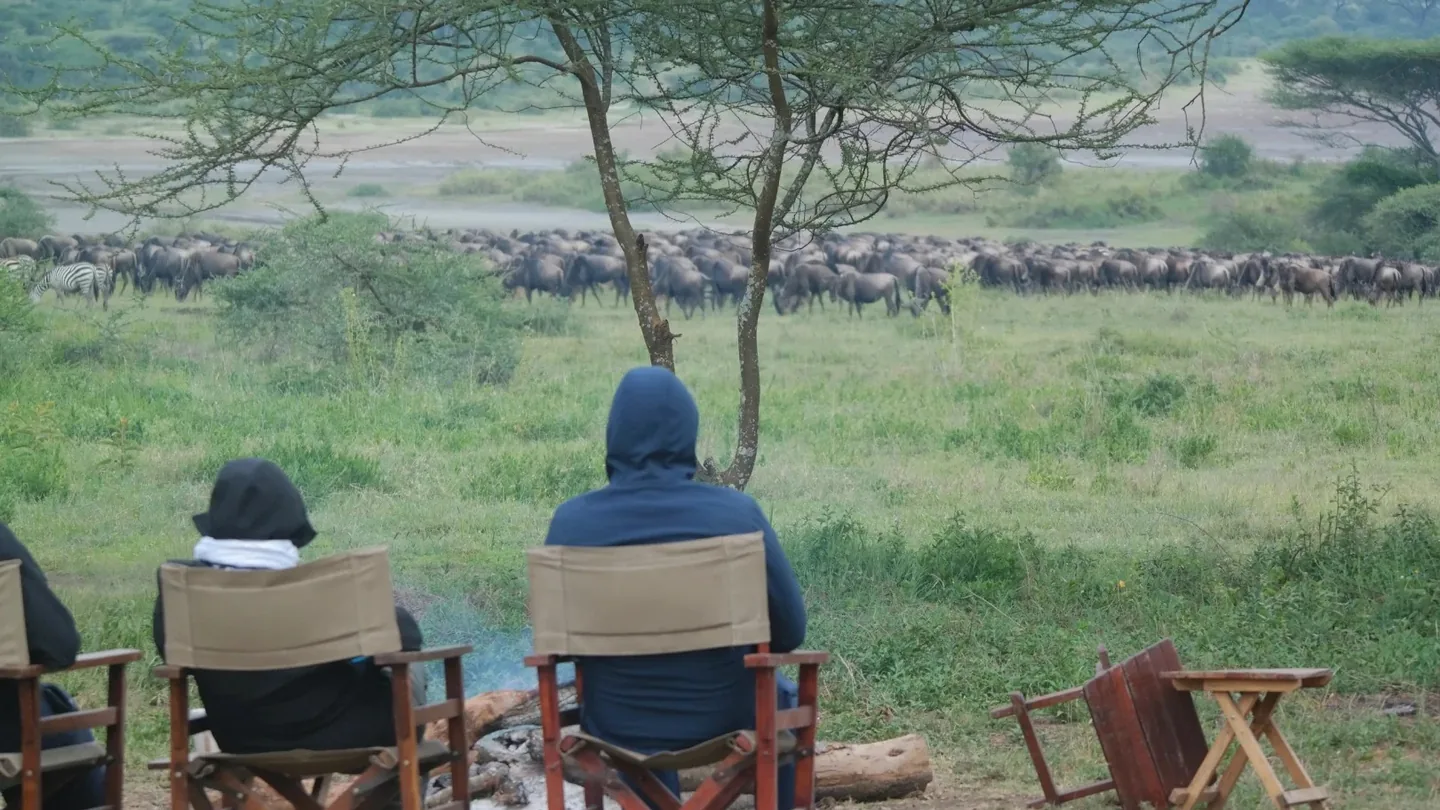
Where you stay matters most when the herds are moving beyond the breakfast table. The Safari Atlas
The quick answer
South (Ndutu and the southern plains): base here for the calving season, roughly December to March – newborns and intense predator action. North (Kogatende, near the Mara River): base here for the river crossings, roughly July to October. Central (Seronera): the year-round, reliable heartland – superb resident wildlife any month, and the best fallback if your dates don't align with a migration highlight.
So let your travel month choose the region. If you can't match a highlight, central Serengeti is the safe, wildlife-rich default – and many trips combine two regions to follow the herds.
Key facts
- South (Ndutu): calving season, roughly Dec–Mar – hundreds of thousands of newborns and predators.
- North (Kogatende): the Mara River crossings, roughly Jul–Oct – the migration's dramatic peak.
- Central (Seronera): resident wildlife year-round – big cats, the hub, the reliable base any month.
- The regions are far apart: south to north can be a full day's drive or a short bush flight.
- Timings shift yearly with the rains – the migration follows no fixed calendar.
- Combine to follow: pairing two regions (e.g. central + north) tracks the herds instead of hoping.
Dec–Mar
South (Ndutu)
Calving season – newborns and predators on the southern plains.
Year-round
Central (Seronera)
Resident wildlife any month; the reliable heartland and hub.
Jul–Oct
North (Kogatende)
The Mara River crossings – the migration's dramatic peak.
Why the region is a timing question
The Serengeti's magic is that most of its herds are always moving, in a great year-round loop chasing the rains and fresh grass. That means the "best" part of the park is wherever the migration happens to be when you visit – and because the regions are so far apart, basing yourself in the wrong one can leave you a day's drive from the action you came for. The camp's luxury is irrelevant if it's in the empty quarter that month.
So the planning order flips from a normal trip: you fix your dates, work out where the herds will be, and then choose the region and the camp to match – not the other way around. Resident wildlife is superb everywhere all year, so you'll never have a bad safari; but to catch a migration highlight, region and timing have to line up. This is the same logic as our migration month-by-month guide, applied to where you sleep.
South: the calving grounds
The southern Serengeti – the Ndutu area and the short-grass plains that spill toward Ngorongoro – is the migration's nursery. From roughly December to March, and peaking in January and February, hundreds of thousands of wildebeest give birth here in a matter of weeks. The result is one of the great wildlife spectacles: newborns everywhere, and every predator for miles cashing in, so big-cat action is at its most intense.
Base in the south for a green-season, calving-focused trip – it's a quieter, and often cheaper, alternative to the July–October crowds, with drama to match. Camps here are frequently mobile or seasonal, moving with the herds across the plains. If your dates fall in the early months of the year and calving appeals, this is the region to book, as our green season guide and the calving section of the calendar both flag.
See southern Serengeti camps → Ndutu and calving-season camps for December to March. Check datesNorth: the river crossings
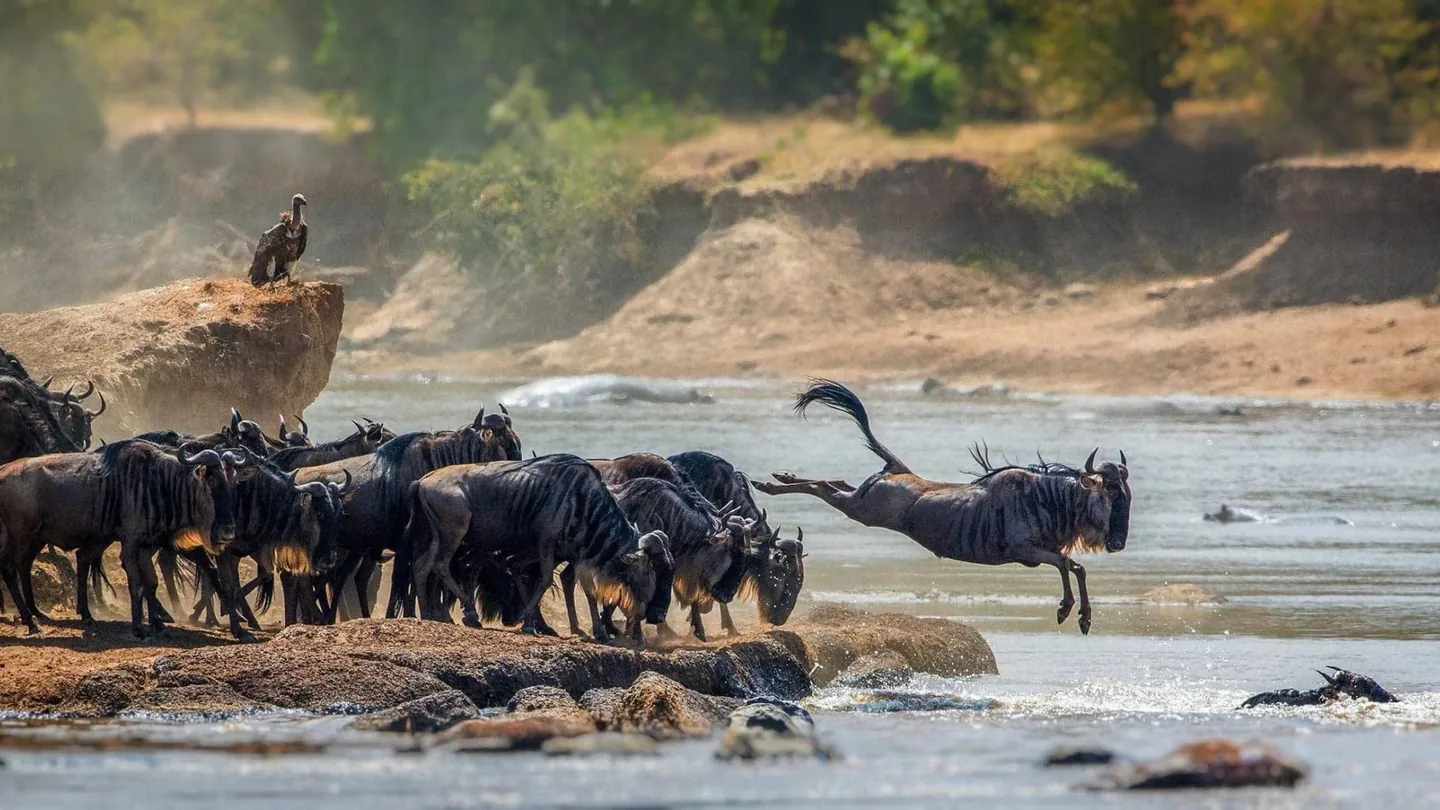
The northern Serengeti, around Kogatende and the Mara River near the Kenyan border, is where the migration reaches its most dramatic. From roughly July to October the herds mass on the riverbanks and pour across the crocodile-filled water in the famous crossings – the scene that defines the Great Migration in most people's imaginations. It's remote, wilder and less developed than the central hub, with a genuine end-of-the-earth feel.
Base in the north to chase the crossings, but go in with realistic expectations: crossings are unpredictable, happening on the herds' schedule, not yours, so a few days here gives you the best odds rather than a guarantee. This is peak season – the priciest and, at the crossing points, the busiest window – and it's worth flying in rather than enduring the long drive from the south. If the crossings are your dream, the north from July to October is the place, echoing our Serengeti vs Maasai Mara comparison for the crossing story.
Which Serengeti region matches your dates?
The right region follows the migration, and the timing shifts each year. Tell us your travel month and what you most want – calving, the crossings, or reliable year-round game – and our safari planning team will place you in the right region and cost camps to match. No obligation.
Central: the reliable heartland
The central Serengeti, around Seronera, is the park's heartland and its logistical hub – and it's the answer whenever the migration isn't the point. Its rivers and woodland hold superb resident wildlife year-round: some of the best big-cat viewing in Africa, plus elephant, giraffe and plains game that don't migrate. Whatever month you visit, the central Serengeti reliably delivers a great safari, which is exactly why it's the safe default.
Base here if your dates don't line up with a calving or crossing highlight, if it's your first Serengeti trip and you want certainty, or if you simply want dependable big-cat action without chasing the herds. The trade is that it's busier and more developed than the remote north or the seasonal south – more camps, more vehicles at popular sightings. But for sheer reliability, central is unbeatable, and it makes an ideal anchor for a two-region trip.
Where the herds are, by month
The migration's rough position through the year, mapped onto the three regions. Find your travel month and read which region to base in; central works in any of them.
Migration position by month · typical, shifts yearly
| Region | Best window | The draw |
|---|---|---|
| South (Ndutu) | Dec–Mar | Calving, predators |
| Central (Seronera) | Year-round | Resident big cats |
| North (Kogatende) | Jul–Oct | River crossings |
Combining regions
For a longer or more serious Serengeti trip, the smartest move is often to base in two regions rather than one – and fly between them to save the long drive. Pairing the central heartland with the north in the dry season, for instance, gives you reliable big cats plus a shot at the crossings; or central with the south in the early year combines resident wildlife with the calving. Following the migration this way beats parking in one camp and hoping the herds come to you.
Because the regions are so far apart, a bush flight between them is usually well worth the cost – it turns a day lost to driving into extra game-viewing time, exactly the trade our fly-in vs driving guide weighs. On a first, shorter trip, one well-chosen region is plenty; on a longer one, a two-region route is how you see the Serengeti at its best.
Browse Serengeti camps by region → South, central and north camps, matched to the migration by month. See optionsFive questions to ask before you book a region
- What month am I travelling? This, more than anything, decides the right region.
- Calving or crossings? Calving means the south (Dec–Mar); crossings mean the north (Jul–Oct).
- Do my dates miss both? If so, central Serengeti is the reliable, year-round choice.
- Should I combine regions? On a longer trip, two regions plus a bush flight follows the herds.
- Is the camp actually where the herds will be? Confirm the camp's location matches the month, not just the park.
So where should you stay?
For a December-to-March trip built around the calving. Newborns in their hundreds of thousands and the year's most intense predator action, on the quieter, greener southern plains.
For the Mara River crossings, July to October. Remote and dramatic – fly in, give it a few days for the odds, and accept that the crossings run on the herds' schedule, not yours.
For reliable, year-round game and as the anchor of any trip. When your dates don't match a highlight, or it's your first Serengeti, the heartland's big cats never disappoint.
Fix your dates first, find the herds second, and choose the region third – never the reverse. Get that order right and the Serengeti delivers its headline act; get it wrong and you're a day's drive from the show. When in doubt, anchor in the central heartland and build out from there.
Regional migration timings are typical 2026 patterns and shift year to year with the rains – the herds follow no fixed calendar. Camp locations vary. Confirm the exact position of the migration for your dates and the location of any camp with your operator before booking.
Sources & notes
Regional migration windows (south/Ndutu calving Dec-Mar; north/Kogatende crossings Jul-Oct; central/Seronera year-round resident game) are indicative and shift each year with the rains. Timings shift each year with the rains and are indicative, not fixed – confirm the migration's likely position for your dates and the exact location of any camp with your operator before booking.