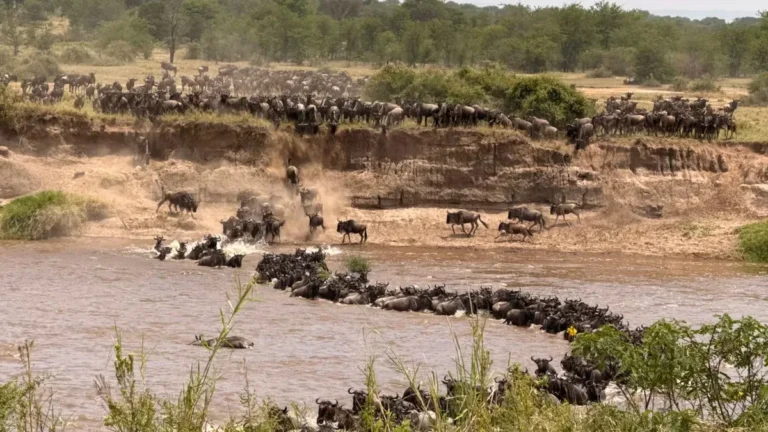
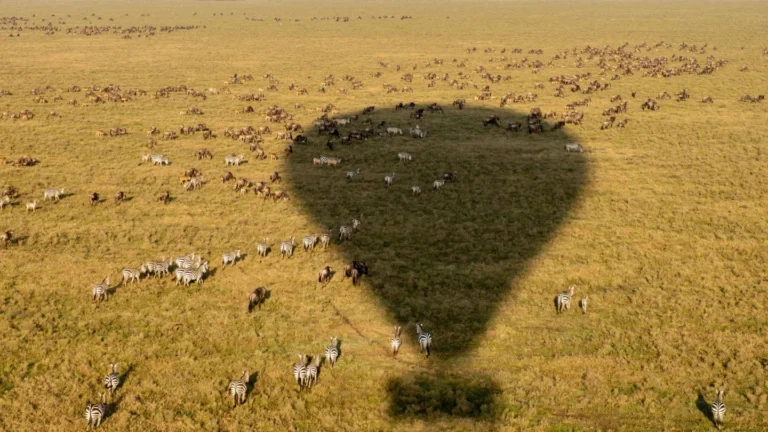
Both countries share the same ecosystem, the same migration and most of the same animals. The border running through it is a political line, not a wildlife one. What actually differs is scale, cost, travel time and how much of your trip you’ll spend in a vehicle.
Key facts
- One ecosystem, two countries: the Maasai Mara (Kenya) and the Serengeti (Tanzania) share the same plains; the Serengeti is roughly ten times larger (about 14,750 km² vs 1,510 km²).
- Cost: plan on roughly $250–$500 per person per day in Kenya and $350–$700 in Tanzania (mid-range, two sharing) – the gap is mostly park fees and internal flights.
- The migration is a year-round loop: calving Jan–Mar on the southern Serengeti, Mara River crossings roughly Jul–Oct, in both countries.
- Timing decides the country: February favours Tanzania for calving; in August either works, so choose on camp and vehicle, not the flag.
- The bigger choice: a public park (busy, on-track only, gates 6am–6pm, no night drives) versus a private conservancy (capped vehicles, off-road driving, night drives).
- Best for a first or short trip: Kenya, for compact routes and quick Nairobi access; Tanzania for scale and remoteness.
Start with what’s actually the same
The Maasai Mara and the Serengeti are one ecosystem. Same grassland, same herds, same predators following them. A lion doesn’t get stopped at immigration.
So most of what you read comparing “Kenyan wildlife” to “Tanzanian wildlife” is noise. Big Five in both. Great Migration in both, at different times of year. Cheetahs, hippos, thousands of zebra. If someone tells you one country has better animals, they’re selling something.
The real differences are logistical, and they’re worth understanding, because they change how your days feel.
One ecosystem, two countries
The Serengeti is roughly ten times the size of the Maasai Mara National Reserve. Same plains, same herds — the border just runs through the middle.
Roughly the size of Northern Ireland. Drives between areas take hours.
Reserve only. Add the conservancies and the wider Mara roughly doubles.
Bars drawn to scale by area. Area figures: TANAPA and Kenya Tourism Board.
Scale cuts both ways
Tanzania’s advantage is space. The Serengeti is enormous, and once you’re deep in it you can go a long while without seeing another vehicle. That matters to some people more than anything else on the trip.
The cost of that space is time. Distances are long, roads are rough, and a “3-hour transfer” on paper can eat your morning. Fly-in solves it and adds a few hundred dollars a leg.
Kenya is more compact. The Mara is smaller, so you cover more of it per drive, and the drive from Nairobi is manageable — or a short flight if you’d rather not spend a day on the road. On a five-night trip that difference is enormous. On a twelve-night trip it barely registers.
Which is the whole point: the shorter your trip, the more Kenya makes sense.
The migration is a loop, not a place
This trips up almost everyone. The Great Migration is a year-round circuit, not a single event in Kenya. The Mara River runs through both the Maasai Mara in Kenya and northern Serengeti in Tanzania, and crossings can happen in either country. So “which country for the migration” is really “which month are you free?”
Where the herds are, month by month
The wildebeest spend most of the year in Tanzania. The famous crossings take place at different points along the Mara River in both northern Serengeti and the Maasai Mara.
Tanzania
Calving season on the southern plains and Ndutu. Hundreds of thousands of newborn wildebeest, and every predator in the ecosystem paying attention.
Tanzania
The herds move north through the Serengeti. Green season, fewer vehicles, lower prices.
Kenya
Mara River crossings occur at different points in northern Serengeti and the Maasai Mara. Herd locations shift with the rains, so either country can work in this period.
Aug–Sep: peak crossings, peak pricesTanzania
The herds return south, following the short rains back to the calving grounds.
Timing shifts with the rains and varies year to year.
Read that chart and the answer falls out on its own. Free in February? Tanzania, no contest — the calving season on the southern plains puts hundreds of thousands of newborn wildebeest in one place, with every predator in the ecosystem paying attention. It’s arguably a better spectacle than the river crossings, and nobody talks about it.
Free in August? Either country works. The herds are straddling the border. Book on price, transfers and camp quality instead.
What each one costs
Tanzania is generally the more expensive of the two, and the gap comes mostly from fees and internal flights rather than from lodges.
Lower park fees outside the Mara. Nairobi is a cheap, well-connected hub. Short flights to the Mara are common and affordable.
Higher park and concession fees, plus the Ngorongoro Crater fee. Longer distances often push you into an internal flight.
Broad editorial planning ranges for two travellers sharing a mid-range private itinerary, not quotes or a market survey. Inclusions, season and routing can move the total substantially; park fees change regularly, so check current rates before budgeting.
Two things flatten that gap. Kenya’s Mara reserve fees rose sharply in recent years, so the cheap-Kenya reputation is a bit out of date. And in either country, a badly routed itinerary costs more than an expensive lodge — you pay for the days you spend driving as surely as the days you spend watching lions.
The decision that matters more than the country
Here’s the part nobody puts in the headline.
Inside a national park or national reserve — Serengeti, Mara Reserve — the rules are strict and the same for everyone. You stay on the authorized tracks; off-road driving is prohibited and enforced with real fines. Gates open at 6am and close at 6pm, which rules out night drives. Walking is possible in the Serengeti, but only as a booked activity: armed ranger, fixed route, four guests maximum, over-12s only, indemnity form signed at the gate. It isn’t something you decide to do over breakfast.
And any vehicle that paid the gate fee can be at the same sighting as you. In high season, twenty of them will be.
In a private conservancy or concession, the operator controls access. Fewer vehicles, capped by bed count. Off-road driving to reach a sighting. Night drives, when a completely different set of animals is out. Walking and night activities are often easier to arrange, subject to the conservancy and camp’s own rules. It’s a different experience from the same landscape.
Kenya’s conservancy model around the Mara is the more established of the two, and in our view the more consistent. Tanzania has concessions offering similar access, but they’re fewer and vary more from one to the next.
Torn between the two? We’ll match you
Tell us your dates, budget and what you most want to see – the crossings, the calving, or just the classic plains. Our safari planning team will tell you which country fits, and send back a costed itinerary. No obligation.
A word about the Ngorongoro Crater
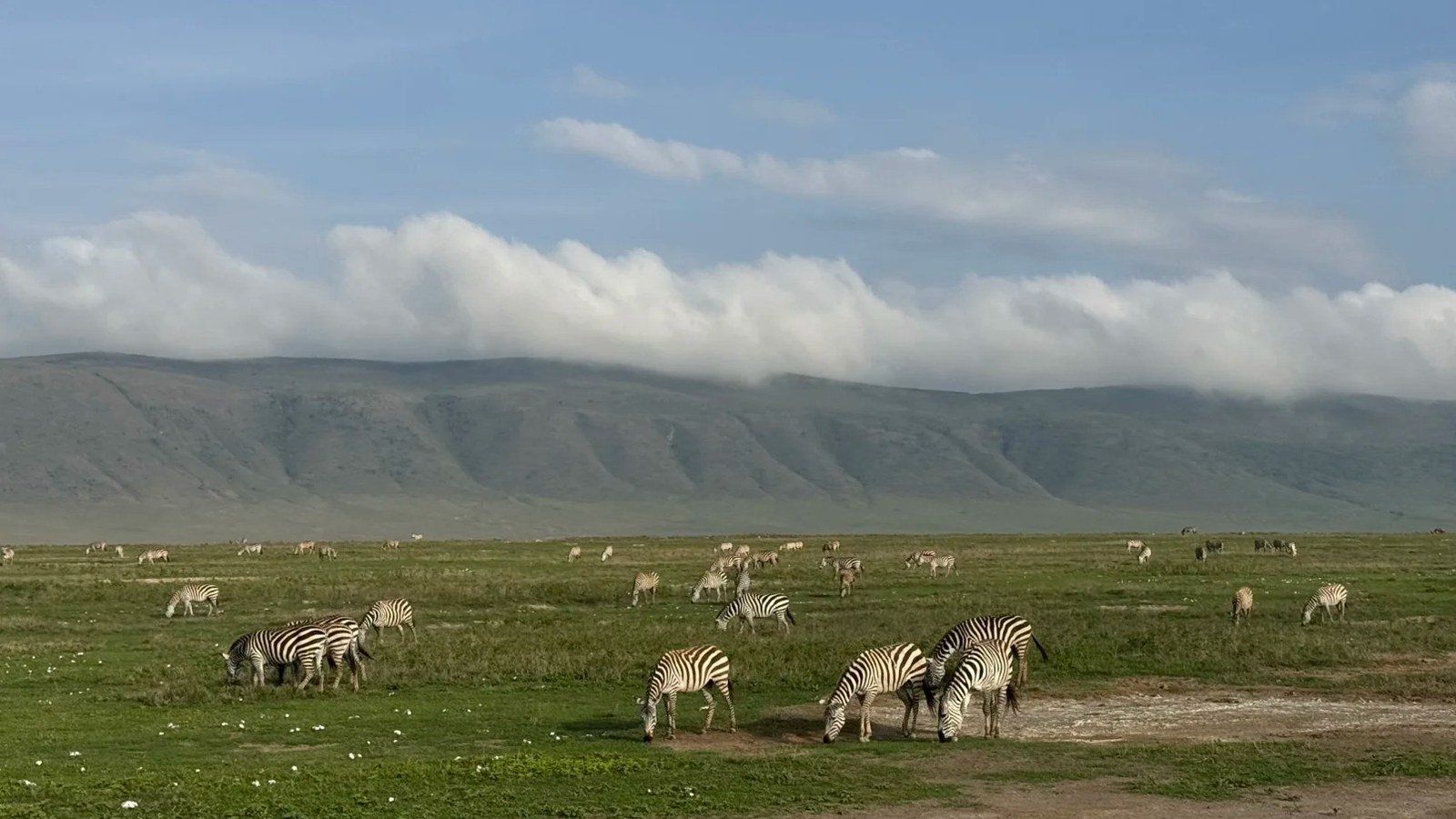
It’s on every Tanzania itinerary, it’s genuinely beautiful, and it’s one of the few places you might tick off all of the Big Five before lunch.
It’s also small, walled, and busy. At peak times the crater floor has a lot of vehicles on it, and a lion sighting can draw a queue. Some travellers find the density of animals worth it and don’t care. Others describe it, quietly and afterwards, as feeling a bit like a very scenic zoo. Both reactions are fair.
Our preference, for a first trip: go, but go once, and we wouldn’t make it the reason you pick Tanzania. For most travellers one morning on the crater floor is enough, and the rest of the trip is better spent somewhere you can breathe. If a guaranteed Big Five morning is what you came for, though, that logic doesn’t apply to you.
You don’t have to pick, but you probably should
Combining both is possible. Fly Nairobi to the Serengeti, or cross at Isebania overland if you have the patience. Plenty of people do it.
We’d usually talk you out of it on a first trip under ten nights. Two countries means two sets of park fees, an extra flight, a border, and days spent moving rather than watching. You end up seeing the same ecosystem twice from a different postcode, and paying for the privilege.
Longer than ten nights, or a second safari? Then yes, it’s a good idea.
One country, more nights
Fewer transfers, lower fees, more time actually parked next to something. This is the right answer for most first trips.
Both, with a flight
Worth it on longer trips. Budget for the internal flight rather than trying to save money on a long overland border day.
Ask these before you compare quotes
- Is this camp inside the national park, in a conservancy, or outside the gate?
- Which month am I travelling, and where will the herds actually be then?
- How many hours of this itinerary are transfers, and can a flight replace any of them?
- Are park fees, the crater fee and internal flights in the price, or added later?
- Can we drive off-road and at night here, or not?
So, which one?
Choose Kenya if it’s your first safari, you have a week or less, you want conservancies, or you’re adding a beach week afterwards.
Choose Tanzania if you’re travelling in February for calving, you want scale and remoteness, or you’ve done the Mara already.
Choose either if you’re going in August. Seriously. Spend your energy on the camp’s location and the vehicle instead — those will shape your trip far more than the flag at the gate.
Sources & notes
Park fees follow the official schedules: Tanzania via the Tanzania National Parks (TANAPA) tariff (VAT included) and the Ngorongoro Conservation Area Authority; Kenya’s Maasai Mara via the Narok County fee schedule (non-resident adult $100 Jan–Jun, $200 Jul–Dec, each ticket valid 12 hours). Gate hours (roughly 6am–6pm) and Serengeti walking-safari rules (armed ranger, maximum four guests, age 12+) follow TANAPA regulations. The per-day cost ranges are editorial planning estimates for two people sharing a mid-range private trip, not quotes. Confirm current fees and inclusions with your operator before booking.